
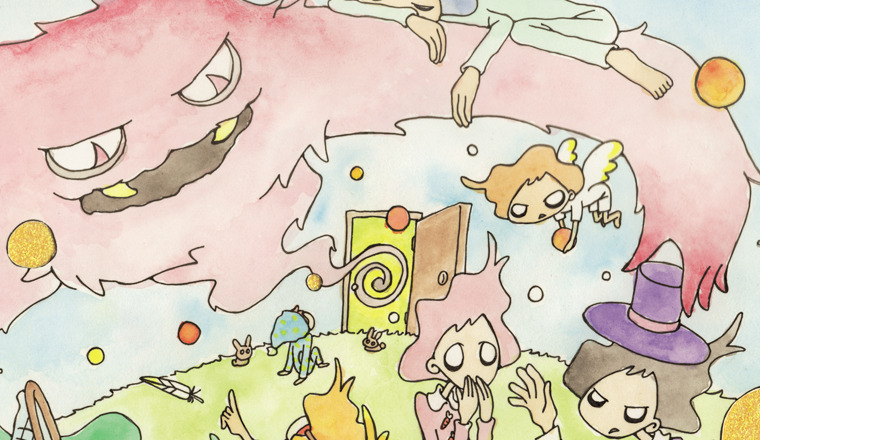
Grab your blanket and pillow. Rest your head down. Fairway takes a look at the Kickstarter game, Project Dreamscape, by Undine Studios. Project Dreamscape is a one- to four-player, card chaining, set collection game that puts players in charge of a somewhat freaky lab attempting to control the sleeping minds of the research participants. Find out if Fairway is now afraid of the night!
I backed Project Dreamscape when it was on Kickstarter because I thought the theme was so dreamy. Turns out that Project Dreamscape’s card-chaining, drafting and set collection mechanisms work really well.
Initial Impressions ^
- The Project Dreamscape art is dreamy and cute
- Even though the cards have some tricky mechanisms, the rules are very well done
- The learning curve is relatively low and the game is easily teachable
- The game plays quickly
Game play ^
In Project Dreamscape, players want to be the best sleep researcher. To do so, players create chains of matching cards representing eight different dream states. The longer the chains of similar dream types, the more points. And the player with the most points at the end of the game, wins.
Project Dreamscape is played over the course of many turns. In general, a turn consists of: collecting Zs (optionally), drawing cards from a central marketplace (called the Dreamscape), and playing the cards to your own chain. How many cards a player can take from the Dreamscape on a turn is limited by the number of Zs that player has. However, taking too many Zs will cost points at the end of the game.
Cards from the Dreamscape are played to the player’s chain. Each Dreamscape card contains two different dream types: one on the top of the card, the other on the bottom. When played, both dream types count for chains, but players must also choose one the powers to use when played.
 As the game advances the chains of potential events gets longer and longer. At the end, the players total up the points for all of the chains in their dream sequence and subtract any collected Zs.
The game also includes a few variations as well as a solo play option. The solo play game’s base mechanics are the same, but alters some of the effects.
On the Green ^
Project Dreamscape is neat little game that has a number of things going for it.
 Easy to teach, but still strategic. The game is pretty quick and is easily taught and learned. The basics of buy-a-card and then chain-your-cards together are readily understandable. But, it leaves a lot of room for strategic decisions and getting long chains requires a good amount of planning.
Effects. The choice of effects on each of the cards is interesting. There’s a lot of fun in trying to plan the chains to get long sets of repeats. The fact that you can select among two effects helps mitigate the luck-of-the-draw.
Dreamy Art. The art is super cute, even for the “scary” dream types. There isn’t a ton of unique art elements, each card is just a combination of the handful of effects.
Nice components. The components are all nice: linen finished cards and thick cardboard box and chits. There’s also a nice cardboard divider in the box for the cards–handy since there are two different kind of decks.
Solo Play! I like the solo play version of this game a lot. It’s a bit puzzle-solving and a bit solitaire. There’s a few minor rules changes to make certain cards work correctly, but it’s a very good implementation.
Where it comes up short ^
 Project Dreamscape plays well, but there are a few things to note:
Uneven effects. There’s a handful of effects that just feel underpowered compared to some of the others. In particular, having the other player discard a Z card and getting to draw another Z card. In each case, it’s mostly like giving the other player points–Z cards in your hand at the end of the game are negative points. Plus, since they don’t allow multiple plays, the strategic value goes down.
By contrast, “free floating” and “shared dreaming” cards are both powerful and useful in that they allow repeated actions that can entirely rearrange the player’s chain. Unlike the underpowered effects, the game wouldn’t be the same without these.
Keeping track of your opponent’s chains. When the other player invoked long chain of effects (as was common with the free floating effect), it was often really hard to “check” that the player doing the moves was doing it correctly since it often went by so quickly. I could see someone using this as an opportunity to cheat or unwittingly make a mistake.
Winning by surprise. Figuring out who’s winning is like waking up from a dream and then taking stock: it’s hard to know if you’re ahead or behind and even harder to know by how much. Scoring is only simple at the end. Because longer chains are worth more per card and cards can be moved through your dreamscape, it’s hard to know where you are compared to other players or whether it’s worth it to break this chain to improve another. You only have the vaguest sense of who’s actually winning.
 In the Hole ^
Project Dreamscape is a neat, light and relatively quick game. It’s portable enough to bring with you to play just about anywhere. The game play introduces a number of things that are so satisfying to do, like making those long chains. While the theme makes it somewhat hard to explain, the actual gameplay has a very low learning curve. Project Dreamscape is good fun for a family of gamers or as something different to play.
Project Dreamscape is in the hole for a Par. ^